Introduction
If building a wall on the floor and raising it into position is not practical in your situation, begin by cutting the top and bottom plates, and marking them for studs (see Building a Wall, Related Projects). Transfer the marks to the faces of the plates, making sure the marks are clear so you can see them easily to align the studs while toenailing.
|
1. Install top and bottom plates
Nail the top plate to the joists. Use a level and a straight board to mark the location of the bottom plate or use a chalk line case as a plumb bob. Mark the floor in two places and make an X to indicate on which side of the mark the plate should be positioned. Use masonry nails or a power hammer to fasten the bottom plate to the floor (see Furring Basement Walls, Related Projects). |
|
|
2. Cut and install the studs
With top and bottom plates installed, measure the required length of each stud individually. Add 1/16 inch for a snug fit and cut. Tap each stud into place. If you really have to whack it to get it into place, it is too long. Don't risk splitting the stud; take it down and trim it a little. |
|
|
3. Toenail the studs
To secure the studs, drive 8-penny nails at an angle through the side of studs and into the plate; this is called toenailing. Tap the nail once or twice while holding it parallel to the floor or ceiling. When the nail tip bites into the wood, change the angle to 45 degrees. Drive four to six nails into each joint, two on each side, with an optional one at the front and back. The first nail may move the stud, but the second nail, driven from the other side, will move it back.
If you have difficulty toenailing, drill pilot holes for the nails, using a 3/32-inch bit. Or, place a 14-1/2-inch board between studs to serve as a temporary nailing brace.
|
|
|
4. Frame at corners
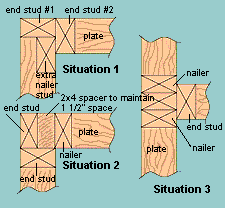
When framing corners, make sure there is a nailing surface for every piece of drywall or paneling that will be installed. This means adding nonstructural nailers.
In Situation 1, right, the extra stud is turned sideways to offer a nailing surface and strengthen the corner. Drive 16-penny nails first through end stud #1 and into the extra stud, then through end stud #2 and into the extra stud and end stud #1.
In Situation 2, right, several foot-long 2x4 scraps (usually three in a standard 8-foot wall) serve as spacers between two full-length studs placed at the end of one wall. Tie the wall sections together with 16-penny nails.
Situation 3, right, shows two intersecting walls. Nail three studs together and to the plates, then attach to the adjoining wall. |
|
