Introduction
The deck has become an essential feature of many North American homes. Whether for sipping that final cup of coffee on a summer's morning, lounging on a sleepy Sunday afternoon, or throwing together a casual meal for close friends, a deck is the platform of choice for relaxed outdoor living.
Not only is a deck fun to use, it can be fun to build. Most decks can be completed in several weekends without the need for finely tuned carpentry skills. Unlike many remodeling projects, a deck doesn't disrupt your household; the hubbub of construction is safely outdoors.
While decks are fairly straightforward to build, there are many pitfalls to avoid if you are to end up with a well-constructed, long-lasting deck. Perhaps you've heard of decks collapsing because they were not attached properly to houses or were built with framing members that weren't up to the job. Or maybe you've seen how quickly decks can rot if the wrong lumber is used or if members are fastened without concern for moisture defense. Checking a few details as you plan and build your deck will help you avoid such shortcomings.
|
Anatomy of a deck
At first glance, a deck looks like a simple tablelike structure. In fact, decks are comprised of layers of construction, each with its own name and specific function. By taking the time to learn the anatomy of a deck, you will be well on your way to understanding the steps required to construct one. The illustration above and the following text identify all of the important components of a typical deck. Specific types of decks may differ a bit; such variations are discussed in related topics.
|
|
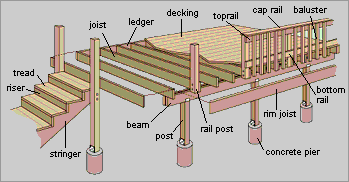
A deck's foundation provides the critical base of the entire structure and ties it to the earth. The exact size and composition of the foundation depends on your climate, the size of the deck, and other considerations, but it normally consists of concrete piers. The foundation must be stationary and strong enough to transfer the load on the deck safely to the ground.
Posts are used on all but the shortest decks. They establish the height of the finished structure. Most decks are built with 4x4 posts. The posts can be cut off below the deck surface or may rise above the surface to provide support for the railing or overhead structure. Posts rest on top of concrete piers.
Anatomy continued
Beams typically are the first horizontal members of the deck, and they usually are the largest members. Beams are attached to the posts. Most decks are connected to houses by a ledger. The ledger functions as another beam, connecting the frame of the deck to the solid foundation of the house.
Joists are the series of boards spanning the distance from beam to beam or beam to ledger. Joists are connected to the ledger with joist hangers; they can overlap, or cantilever, the beam. Joists are spaced 16 or 24 inches on center; that is, they are centered on lines marked every 16 or 24 inches.
A skirt, or fascia board, hides the edges of the joists. The surface layer of the deck is called the decking, or deck boards. Decking is fastened to the joists with nails or screws. If the deck is more than 2 feet above the ground, it should have a railing. While railing designs vary, a standard version consists of rail posts, which tie it to the deck frame; balusters, usually small, vertical pieces that provide the infill; a top rail and bottom rail, to which the balusters are attached; and a cap rail, which sits atop the entire railing.
Stairs are composed of treads (the part you step on), which are fastened to stringers, which are the boards that span the distance from the deck surface to the ground. Risers are the vertical boards that fill in the space between treads. Risers often are not used on deck stairs.
|
Choosing a deck configuration
A well-designed deck should meet your needs and suit the style of your house. Sometimes a simple rectangular deck off the kitchen or family room meets both criteria perfectly. Often, however, circumstances may call for a deck with more drama and variety.
Using the same basic techniques, you can design a deck that wraps around two or more sides of the house. A deck constructed at two or more elevations can be functionally versatile and visually appealing. Decks can serve the ground floor, an upper floor, or both. |
|
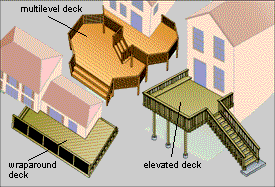
A single deck can serve simultaneously as a balcony, porch, stairway, patio, and walkway. And remember, a deck doesn't have to be connected to the house at all; it can stand alone. Budget limitations and construction requirements may limit your dreams, but don't let them stand in the way of a creative design that could solve other problems as well.
Tip: Avoiding Rot and Water Damage
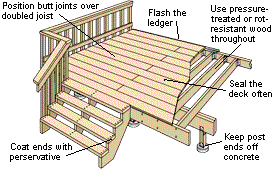
Rot-producing fungus is the biggest enemy of wooden decks. To thrive, the fungus requires permanently moist wood. Here are tips on moisture defense:
|
|