Introduction
You don't need a drafting or architectural degree to produce accurate plan drawings of your deck. But you may need drawn plans to obtain a building permit. Don't be surprised if you are required to have an architect's stamped approval on the plans. Use graph paper to draw elevation and overhead views of your deck to scale (typically 1/4 inch to the foot). Drawing working plans can be tedious, but the work pays off by eliminating all of the guesswork from construction. Add enlarged detail or section drawings of railings, stairs, and other complex components that can't be presented in specific detail on the main drawings.
|
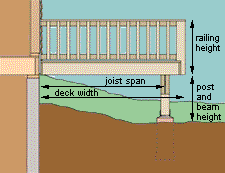
Drawing elevation (side or front) view
An elevation drawing is a vertical view of the deck. It should include each layer of the deck, from footings to railings, with appropriate dimensions given for each. In addition to a side elevation view, you might find it helpful to draw a front elevation, which would be the view if you were looking directly at the house.
|
|
|
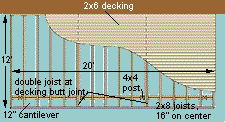
Completing a plan view
Also called a bird's-eye or overhead view, a plan view shows the footprint of the deck. It is particularly important in establishing exact locations for piers, beams, and joists. An accurately scaled plan view not only helps guide the framing of the deck, it allows you to estimate the amount of lumber to buy. The drawing above combines a view of the finished deck with the decking installed and the foundation and framing. On more complex decks, these two perspectives can be drawn separately. Draw the foundation and framing plan first, then use tracing paper to produce the finished view.
|
|