Introduction
Even the best-built decks can't escape weathering. In nearly every case, it is a good idea to apply a protective finish to wood surfaces. Coat the entire deck with a wood finish soon after you finish building it. To get the color you want, perhaps to complement your house, use an exterior stain. Even if you want a weathered look, don't simply let nature take its toll; finishes are available that protect the wood while allowing it to age in appearance. Pressure-treated wood must be finished just like every other type of wood. It should be coated with a water repellent and regularly maintained with finishes that help restore the preservatives in the wood. Redwood and cedar also need protection, especially if they contain light-colored sapwood. Penetrating finishes soak in, while film-forming finishes sit on the surface of the wood.
|
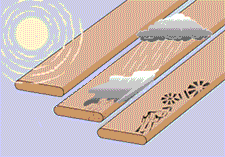
The elements are wood's enemies
The sun's ultraviolet rays penetrate the wood less than 1/64 of an inch, causing only cosmetic damage. But cycles of wetting and drying cause wood to expand and contract, leading to cracking, cupping, and warping. If wood stays moist for a long time, fungus can grow, rotting the wood or producing ugly black mildew. Insects may also be a problem; if they attack houses in your area, expect them to attack your deck.
|
|
|
Stain pressure-treated lumber
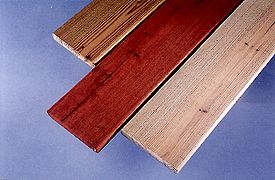
If you use pressure-treated lumber, you don't have to live with that greenish yellow or dirty gray color. By letting the wood dry a bit and applying special stains, you can approximate the look of redwood or cedar. You may need to apply two coats of stain. The bleachlike stain shown on the right-hand board, above, simply was brushed on. For a bit more expense you can buy brown pressure-treated lumber that looks similar to redwood; however, it needs to be restained regularly.
|
|
A rule of thumb formerly was to let your deck dry out under the hot sun for months before applying a finish. Some suppliers of finishes and lumber continue to offer this advice. Don't listen to them. The most important coat of finish your deck receives will be the first one. For a new deck built with pressure-treated lumber, let the decking dry out about two to four weeks, depending on weather conditions. Test the lumber for dryness by sprinkling water on the surface. If it soaks in readily, the surface is ready to receive a finish. Untreated lumber should be finished as soon as it is dry to the touch. If you wait too long, the surface of the wood will have begun to degrade already.
|
Using a penetrating finish
The most common types of penetrating finishes are water repellents, water repellents with preservatives, and semitransparent stains. Water repellents are transparent, protecting the wood from water damage without altering its natural coloration. Water repellents with an added preservative also combat mildew. Ultraviolet (UV) stabilizers are additives used in some clear finishes that offer some protection from sun damage. Semitransparent stains are more durable than water repellents. The pigments used in the stain protect better against sun damage. In addition, penetrating finishes can include an insecticide. Look for products specifically made for use on decks.
|
|
|
Using film-forming finishes sparingly
Film-forming finishes protect wood by creating a solid barrier (film) on the surface. Paint, solid-color stain, lacquer, and varnish are examples of film-forming finishes. None of these products is recommended for use on decking. Varnish and lacquer do not hold up well under sun and rain. Solid color stains weather quickly on horizontal surfaces and are difficult to repair once they fail. Paint offers great protection against water and ultraviolet light, but virtually no protection against mildew. If you want to paint your deck to enhance its appearance, consider painting only the more visible, especially vertical, parts, such as posts and railings. Coat the wood first with a water repellent preservative and liberally prime the end grain before brushing on the paint.
|
|
Ingredient |
Description |
Uses |
Comments |
Water repellent |
Wax, usually paraffin, suspended in a binder |
Prevents water from soaking into the wood |
Easy to apply, but requires annual or biannual applications |
Preservatives |
Typically include a mildewcide, sometimes an insecticide |
Prevents fungi, especially mildew, from growing on the wood; repels insects, such as termites |
Should be used regularly on most decks in most parts of the country |
UV stabilizers |
Reduce degradation of wood due to ultraviolet radiation |
Frequently added to clear finishes |
Generally not as effective as pigment in preventing UV damage |
| Pigment | Ingredient or ingredients that give color to the finish |
Found in paint, solid-color stain, and semitransparent stain |
Protects well against UV and water damage, but ages quickly on decks |
Tip: Getting the Look you Want
The Wet Look.
To get a long-lasting glossy finish that makes your deck always look like it's just rained, you need to spend extra money and exert extra effort. Buy an alkyd resin product made for your type of wood and your conditions. Some of these products do not work well, however, if the deck stays wet for long periods. You will need to apply it in a two-step process.
As Close to the Original Look of the Wood as Possible.
Use a transparent stain containing a UV (ultraviolet ray) stabilizer or blocker. It actually contains a bit of pigment--there's no other way to block out the effects of the sun--which will change the color of the wood slightly. If you don't use a product with UV protection, the sun eventually will change the wood's color much more dramatically.
Silvery Gray. If you use high-quality redwood or cedar, composed entirely of dark-colored heartwood (as opposed to cream-colored sapwood) and leave it untreated, the wood will turn a softly shining gray. By doing nothing, however, you run the risk of cracking and splintering because the wood is not protected from wet-and-dry cycles. If you use a clear product containing water repellent, the wood will turn gray without the cracking. If you let pressure-treated lumber go untreated, it will turn a dirty, not a silvery, gray.
Removing the Gray. If your deck already has turned gray and you don't like it, wash it with wood bleach or fungicide (the color actually is caused by a thin layer of mildew). This will not bring back the original color of the wood, but it will give you a bleached wood that can be stained to the color of your choice.
