Introduction
Fuses serve the same purpose as circuit breakers, but instead of tripping as a breaker does, a fuse contains a strip of metal that melts when too much current in the circuit produces heat. When this happens, you must eliminate the short or overload (see Troubleshooting Circuit Breakers, Related Projects), and replace the blown fuse.
|
Understanding blown fuses
By examining a fuse you usually can tell what made it blow--an overload or a short. A short circuit usually explodes the strip, blackening the fuse window. An overload usually melts it, leaving the window clear.
|
|
|
Fuse options
A tamperproof fuse is an important safety device that makes it impossible to install a fuse with a higher amperage rating than the circuit is designed for. It comes with a threaded adapter that fits permanently into the box. The adapter accepts only a fuse of the proper rating. When an electric motor on a washing machine or refrigerator starts up, it causes a momentary overload, which can blow fuses unnecessarily. A time-delay fuse avoids this problem by not blowing during the surge. Only a sustained overload will blow the fuse.
|
|
|
Cartridge fuses
Fuses for 30- to 60-amp circuits typically are the ferrule-contact cartridge type. Knife-blade-contact fuses carry 70 amps or more. Handle both with extreme caution. Touching either with your bare hand could fatally shock you.
|
|
|
Removing cartridge fuses
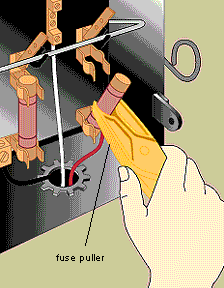
For safety, keep a plastic fuse puller with your spare fuses, and use it as shown. Note, too, that the ends of a cartridge fuse get hot, so don't touch them immediately after you've pulled the fuse.
|
|
|
Testing cartridge fuses
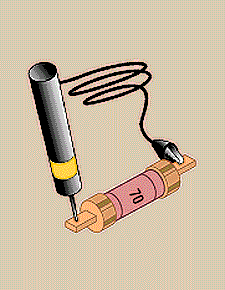
To see if a cartridge fuse has blown, check it with a continuity tester. Clamp or hold the clip on one end, and touch the probe to the other. The bulb will light if it is not blown.
|
|