Lightweight veneers of brick can be an ideal solution.
It's seldom possible to install a single-tier brick wall on an interior wall; floors simply will not support the weight. Even a basement floor can't bear the weight; footings undergird only the foundation walls, not the slab.
However, lightweight veneers can be applied to interior walls, and they look nearly as attractive as real brick. Because they are fire-retardant, you can use them for firewalls behind wood-burning stoves (see Installing a Wood Stove Surround, Related Projects).
|
1. Apply the adhesive
Start in an upper corner of a wall. Spread a 1/8-inch layer of mortar adhesive over a 2x4-foot area.
For outside walls, use roofing nails to nail a moisture barrier of 15-pound roofer's felt and a layer of metal lath to the walls. Then trowel on a coating of mortar, working in 2x3-foot sections.
|
|
|
2. Install the bricks
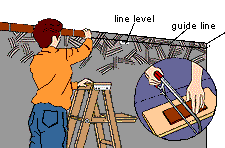
Start at the top of the wall to ensure there will be a full course of brick where appearance counts. Attach a string running the length of the wall, held out from the wall about 1/2 inch, exactly one course down from the ceiling. Use a line level to make sure the string is level. If your ceiling is wavy or out of level, you may need to bring the line down a bit to make room for every brick. Press each brick into the adhesive, twisting it slightly to ensure a good bond. Align the bricks to the string. Leave 3/8 inch between bricks for normal-looking joints. To cut the bricks, use a hacksaw with a masonry cutting blade or rod.
|
|
|
3. Strike the joints
Fill the joints between the bricks with more mortar adhesive or use a colored mortar of your choice after the adhesive has dried. Use either a pencil-type brush or a grout bag with the correct tip. Avoid smearing mortar adhesive on the face of the bricks; wipe up spills immediately. Once the joints have dried, coat the wall with a sealer recommended by the dealer.
|
|