Introduction
Overhead structures can provide function and beauty for your deck. In addition to blocking the sun's rays, the strategically placed slats or boards are attractive architectural features. Even minimal overhead structures give a deck a higher profile, enhancing the deck's role as transition between indoors and outdoors. They also are useful for defining areas of the deck.
Overhead structures can provide complete or minimal shading. Often they shade an eating area, add privacy to a hot tub, or double as a trellis. Overhead structures are easiest to build when designed along with the original deck because all of the structural details can be incorporated into the deck construction. Adding an overhead to an existing deck can be more difficult; posts must be attached to joists. Ideally, overhead posts should rest on footings.
Don't overload
Deck overheads don't have to be built to accommodate the weight of people and furniture. Therefore, they can be made of relatively lightweight materials. A simple overhead composed of well-spaced, uncovered slats or boards does not stress the structure of your deck as long as the posts are sized adequately and supported firmly. However, a solid roof or other structure that will add substantial weight to the deck framing infrastructure should be designed by a professional. In cold climates an overhead may have to support a heavy snow load, even if the overhead itself is lightweight.
|
Building a freestanding overhead
An overhead on a freestanding deck, or one intended to cover only part of a large deck, can be supported by beams spanning the posts. In either case, the overhead must rest on posts, which must be connected either directly to the footings or secured to the deck framing. You may want to consider installing new posts and new footings to support the overhead.
|
|
|
Attaching an overhead to the house
Overheads can be supported in part by a second ledger attached to the house (see Installing the Ledger, Planning and Preparation for ledger installation). Add a beam supported by posts fastened to the deck joists or set on post footings. Attach the beam with brackets, using fasteners recommended by the manufacturer.
|
|
|
Creating an outdoor room
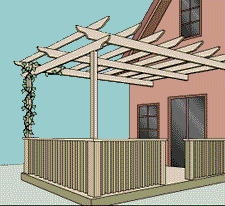
This overhead adds a moderate amount of shade, but mostly lends the stylish illusion of the deck being an outdoor room, making the deck a true extension of the house. Overheads can double as trellises, another means of tying the deck to the yard.
|
|
|
Adding shade with style
For overheads that offer substantial shading, the most appealing designs use several layers of wood, with each layer composed of smaller pieces spaced closer together. The crisscrossed framing adds stability to the structure and gives the deck more of a profile, yet allows plenty of ventilation and drainage.
|
|
|
Adding character with a minimal approach
A few boards, spaced carefully, can cut much of the glare from even noonday sun. In addition, the sense of having something overhead can be an important characteristic of a deck.
|
|
|
Making an overhead a prime attraction
Some overhead structures are designed just for their visual appeal. If style is your primary interest, pay close attention to the details. Try to integrate the design with elements from the rest of the deck or from the house itself. Keep the scale of the overhead in line with its immediate environment.
|
|
|
Varying this basic design to suit your deck
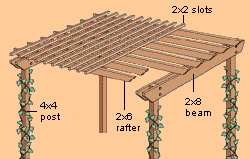
Vary this basic design to suit your deck. This overhead is simple to build and can be adapted easily to provide the degree of shading you want. The double 2x8 beams span from post to post or extend from a ledger to posts. The 2x6 rafters set 16 inches on center can safely span beams up to 12 feet apart. Use rafter ties or 10d nails (through both sides) to fasten rafters to beams. Here, the beam and rafter ends have matching tapers. You can use many decorative designs (see Choose a decorative rafter cut). Attach a top layer of 2x2 slats, spaced 4 to 8 inches apart by driving 8d nails through the slats into the rafters. You may be able to use lattice instead of, or on top of, the slats, but check your local building codes first.
|
|
|
Choosing a decorative rafter cut
A key to designing an attractive overhead structure is to dress up the rafter ends. Find a decorative detail on the house, deck, or in the yard, then transfer that theme to a design for the rafter ends. When you are satisfied with a design, make a template out of plywood, hardboard, or cardboard. Trace the design on each rafter, then make the cut with a sabersaw.
|
|
Knowing when to brace posts supporting an overhead structure can be somewhat confusing. Local codes may not offer definitive answers. Generally, if your overhead is lightweight (consisting of loosely spaced slats, for example) and if one side is connected to a ledger at the house, you almost certainly won't need bracing. At the other end of the scale, assume that you should brace the posts for a top-heavy overhead on a freestanding deck. For everything in between, build the overhead without bracing and check the stability of the structure before deciding. For guidance on bracing, see Bracing Tall Posts, Planning and Preparation.
