Introduction
Deciding what kind of railing to put on your deck is one of the most important design decisions you'll make. Railings are the most visible part of the deck when viewed from the yard or the street, so they'll have a big impact on the look of the deck. Because some railing styles require posts that run continuously up from the footing, you need to plan your railing before you set the posts.
Think about the material you use to build the railing. Just because you build the rest of the deck with pressure-treated pine doesn't mean the railing has to be the same. Given the high visibility of the railing, you may want to use a more attractive alternative, such as cedar or redwood.
On the other hand, you may want to paint the railing to match or complement your house. In this case, pressure-treated pine would be a logical and less-expensive choice even if you use cedar or redwood for the decking.
|
Choosing an optional post design
Deck posts can serve double duty by supporting a beam and continuing up to carry a railing, bench, or overhead structure. With a 4x4 continuous post, the beam should be composed of 2xs attached to each side with carriage or machine bolts. This connection is not as sturdy as when the beam rests on top of the posts. Another option is to use a 6x6 post, resting the beams in notches. This requires a little more preparation and labor, but adds strength and stability to the deck.
|
|
|
Selecting a post connection
Posts bolted to the end or header joists can be strengthened with blocking. This is especially recommended on high decks or if the post will be subjected to heavier-than-normal loads. Blocking must be added from below or before the decking is installed. For header joists, cut a piece of joist stock to fit between the joists and nail it behind the post, as shown here. Bolt through the post, joist, and blocking. For end joists, insert blocking behind the post on one or both sides, as shown here.
|
|

|
Turning railing corners
Here are three techniques you can use for handling the railing at corners. These can be adapted to suit many different railing designs. In each of these options the railing is positioned directly above the end joists. If you want to use a single post in the corner, place it and other rail posts inside the joists. Or you can use two posts set back equidistant from the corner. They can be placed close enough together to meet code requirements, or they can be set apart a bit, as shown, with the space filled in with a short section of the railing. The double posts provide a solid surface for the cap rail, which can support either a 45-degree miter or a 22-1/2-degree mitered section.
|
|
|
Decorating the posts
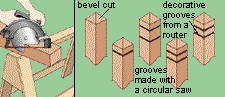
Don't settle for a flat post top. Take a few minutes to decorate the post using a circular saw or tablesaw. Cut identical bevels on each side of the post to create a pointed cap. Not only is this more attractive, it also sheds water and adds longevity to the post. You also can cut grooves around the posts. Sketch out the design you want, then mark cut lines on each post. Using a circular saw or tablesaw, make a single pass for a thin groove or multiple passes for a wider groove. Or use a router with any one of several router bits to make decorative grooves. Getting grooves to line up around the post is tricky. Practice first on some scrap material.
|
|
|
Using post brackets
The folks who make joist hangers, post anchors, seismic ties, and other metal gadgets for joining wood to wood also make a variety of useful brackets for constructing a railing. Several types of brackets are available for securing rail posts to joists. These same brackets also can be used for posts on the stairs. Using brackets saves time, and in some cases they may be your only option for attaching posts.
However, posts attached with brackets won't be as secure as posts bolted to the frame, and the brackets may detract from the appearance of your deck. Brackets also can be useful for attaching rails to posts. The type shown at lower right secures a cap rail while remaining out of sight.
|
|
|
Choosing ready-made components
Traditionally-styled homes shouldn't have decks that look like helipads. Meld your deck with your home by using decorative post caps, spindles, and finials.
Home centers and lumberyards carry many styles of decorative railing parts. Turned balusters, also called spindles, have a traditional look that suits older homes. You usually can find posts with a matching design. Post caps and screw-in finials, often used in combination, quickly transform a drab post top to an eye-catching feature of your deck.
|
|
|
Choosing rail and baluster styles
As long as you meet code requirements for spacing and height, what you use to fill in the spaces between posts is largely up to you. Rails installed "on edge" and attached to the inside or outside face of the posts are least likely to sag. Rails also can be positioned on their flat sides, "on flat," and set between posts, resting on rail brackets or cleats or set into dadoes cut in the posts. Balusters for either system can be identical. The difference is they are nailed on the side of the on-edge rails or at the top and bottom of the on-flat rails.
Railings can be filled in with a variety of materials. Copper or galvanized steel tubing can be used in place of wood balusters. Copper can be coated to preserve its existing color or allowed to age to a graceful blue-green. Steel can be used as it is or painted. Clear acrylic sheets are ideal for maintaining an open view. Some homeowners welded hog fencing to make a surprisingly strong and good-looking railing infill.
Balusters do not have to be vertical. A simple railing can be made with 1x4s or 2x4s attached horizontally to the posts. Metal tubing or wood dowels are attractive when used in this way. Keep in mind, however, that in the eyes of most children, horizontal balusters make an ideal ladder. A railing that encourages climbing can be dangerous, especially if there is a chance of falling over the side. Also, the extra weight and abuse the balusters must bear require they be strong and fastened solidly.
Lattice infill provides more privacy than standard railings, yet allows plenty of air to circulate. The lattice can be fixed in place with stops nailed to the posts and to the top and bottom flat rails (see Framing Latice, Related Projects).
|
|
