Introduction
After getting flipped thousands of times, a switch can wear out. Unless the problem is a loose wire connection, there is usually no way to repair a faulty switch; you'll need to replace it.
It is easy to test switches and easy to replace them. If you want to replace your old switch with something more sophisticated -- for example, a dimmer -- check out the switch options presented in Choosing Switches, Related Projects.
|
Using a neon tester
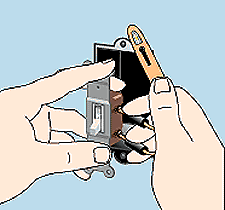
NOTE: Shut off power. Remove the cover plate and the screws holding the switch. Pull the switch out from the box. Turn the switch to OFF and restore power to the circuit. Touch the probes of a neon tester to the switch's screw terminals. If the tester glows, the box has power. Turn the switch on. Touch the probes to the terminals again. If the tester glows this time, the switch is blown and must be replaced.
|
|
|
Using a continuity tester
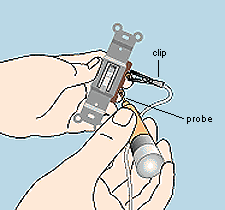
An easy way to test a switch is to use a continuity tester. Shut down the circuit leading to the switch, and remove the switch from the box -- all wires should be disconnected. Attach the tester clip to one of the terminals, and touch the probe to the other. If the switch is working, the tester will glow when the switch is on and not glow when the switch is off.
|
|
|
Testing a three-way switch
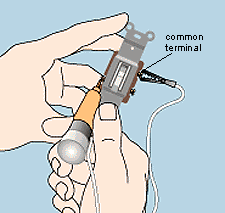
To check out a three-way switch, shut off the circuit and attach the clip to the common terminal (it's usually labeled on the switch body). Touch the probe to one of the other screw terminals, and flip the switch. If it's OK, the tester will light when touching one of the two terminals. Flip the switch. The tester should light when the other terminal is touched. |
|
|
Test a switch or receptacle
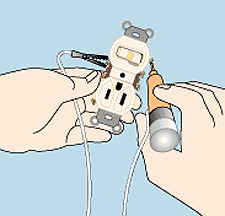
To test a device that has both a switch and a receptacle, attach the continuity tester clip to one of the top (switch) terminals and touch the probe to the top terminal on the other side. If the switch is working, the tester will glow when the switch is on, and not glow when it is off. |
|
|
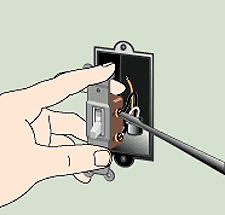
1. To replace a switch, remove the old switch
If a switch is damaged, shut off power to the circuit, remove the screws holding the switch to the box, and gently pull out the device. Loosen the screw terminals and disconnect the wires. |
|
|
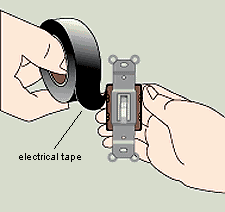
2. Attach wires to the new switch
Inspect the wires in the box, and wrap any damaged insulation with electrical tape. Attach the wires to the terminals of the new switch, and wrap electrical tape around the body of the switch, so the terminals are covered. |
|
|
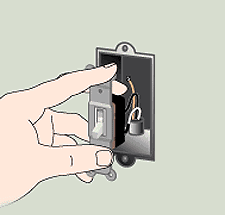
3. Reinstall the switch
Carefully tuck the wires and switch back into the box, and connect the switch to the box by tightening the mounting screws. Don't force anything; switches crack easily. |
|
|
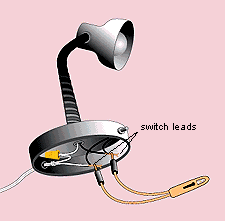
Testing a fixture-mounted switch
Small switches that mount on fixtures work by pull chain, flipping up and down, or twisting. These switches are not long-lived, so if the light does not work and the bulb is not blown, there is a good chance that the problem is with the switch. To test, shut off power to the fixture (or unplug it). Remove the connectors holding the switch's leads. Leave the bare wires twisted together, and arrange them so the connections are not in danger of touching each other or anything else. Restore power to the fixture and carefully touch a neon tester to the connections. If the switch is turned on and the tester lights, the switch is bad. |
|
|
Replacing a fixture-mounted switch
NOTE: Shut off power. Remove the fixture and disconnect the wires. Release the pull-chain switch by loosening the terminal screws and two screws in the base of the socket. Install a replacement switch and remount the fixture.
Other porcelain fixtures have an integrated switch. In such cases, replace the entire fixture. Lamp pull chains cannot be repaired. Buy a new pull-chain socket and replace the old one (see Replacing Lamp Sockets, Related Projects).
|
|
